
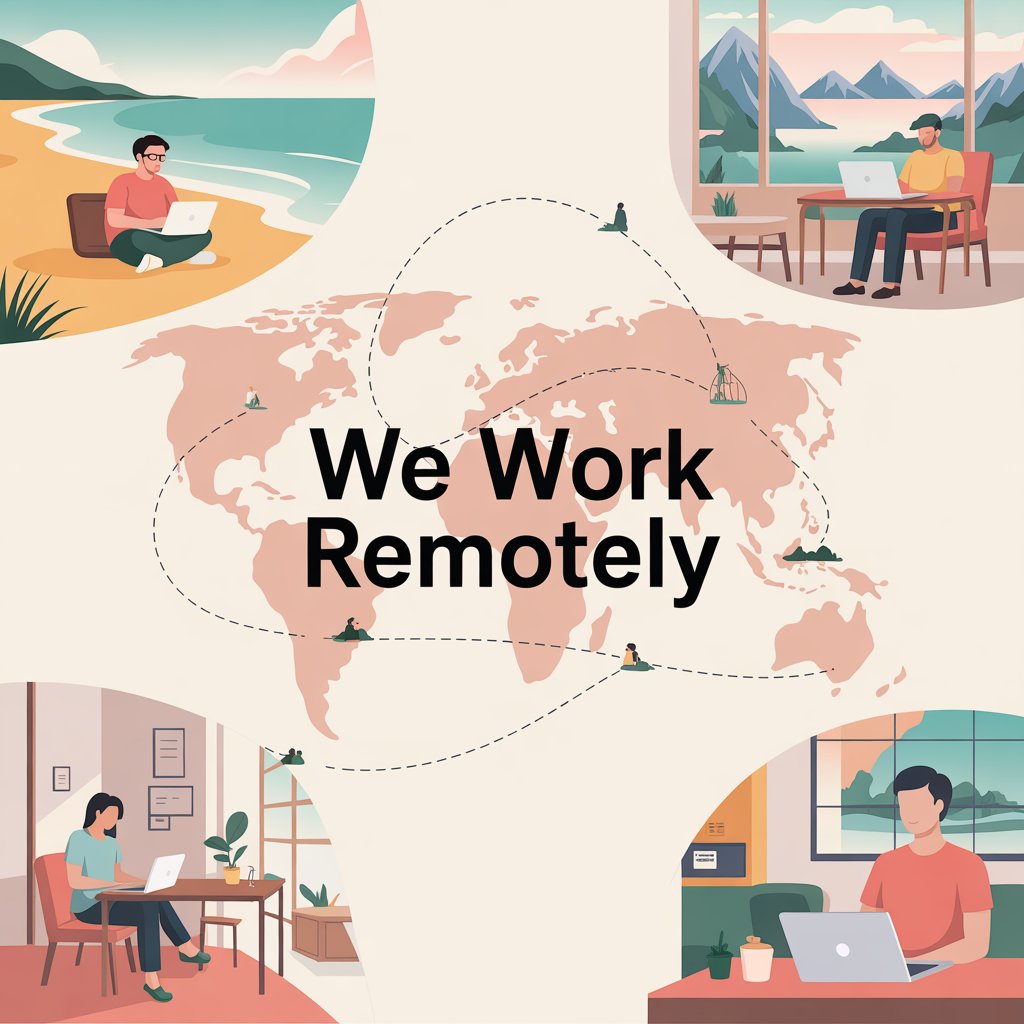
🚀 Introduction: What is We Work Remotely?
We Work Remotely is one of the world’s largest and most respected remote-only job boards, specializing exclusively in 100% remote positions. Unlike general job platforms that mix on-site, hybrid, and remote roles, We Work Remotely features only remote job opportunities from global companies, startups, scale-ups, and tech firms worldwide.
Founded to cater specifically to the remote work movement, We Work Remotely has become the go-to platform for professionals seeking work-from-anywhere opportunities. The platform hosts tens of thousands of job listings from companies across the US, Europe, Asia, Australia, and beyond—all committed to hiring remote talent.
What makes We Work Remotely particularly valuable for Indian professionals is its curated nature. Every job listing on the platform is 100% remote, meaning no office requirements, no relocation expectations, and no geographic constraints. The platform attracts high-quality employers—tech companies, venture-backed startups, and established enterprises that genuinely understand and value remote work culture.
For Indian job seekers, We Work Remotely represents access to the global job market without the barriers of traditional hiring platforms.
✨ Why We Work Remotely is Ideal for Indian Job Seekers
1. No Office or Location-Based Roles
This is the platform’s core strength. Every single job listed on We Work Remotely is 100% remote. You’ll never waste time filtering out on-site positions or hybrid roles. Every opportunity is explicitly designed for work-from-anywhere.
This clarity saves you time and ensures you’re only looking at roles that actually offer the flexibility you want.
2. International Companies Open to Global Talent
We Work Remotely attracts global companies that actively hire across borders. Unlike some job boards where Indian applications get deprioritized, We Work Remotely companies explicitly welcome talent from India, Southeast Asia, Eastern Europe, and beyond.
Major companies hiring on We Work Remotely include:
- Tech Giants: Google, Amazon, Microsoft, Apple, Meta (limited remote roles)
- High-Growth Startups: Stripe, Figma, Notion, Canva, Calendly, GitLab
- Developer Tools: GitHub, GitLab, JetBrains, Atlassian
- SaaS Companies: Basecamp, Automattic, Zapier, Buffer, ConvertKit
- Design & Creative: InVision, Abstract, Dribbble, 99designs
- Fintech: Wise, Kraken, Bitstamp, Uphold
These companies have successfully hired remote teams globally and are equipped to handle international hiring processes.
3. High-Quality, Spam-Free Listings
We Work Remotely maintains strict curation standards. Jobs are manually reviewed before posting, which dramatically reduces spam, scams, and low-quality listings. You won’t see fake job postings or obvious scams on We Work Remotely—the vetting process eliminates them.
This quality filter saves you time and protects you from wasting applications on unreliable employers.
4. Salaries Paid in USD (Global Standards)
Most positions on We Work Remotely offer salaries in USD or other global currencies. This is crucial for Indian professionals because USD salaries are significantly higher than INR equivalents for the same skill level.
A senior software engineer might earn ₹25-30 LPA in India but $120,000-$160,000 USD on We Work Remotely—approximately 5-6x higher. This salary advantage compounds over the years and represents life-changing income potential.
5. Transparent Company Information
Every job listing includes:
- Company name and website
- Detailed job description
- Required and desired skills
- Salary range (usually)
- Time-zone preferences/requirements
- Benefits and perks
- Application instructions
This transparency helps you assess opportunities before investing time in applications.
💼 Types of Remote Jobs Available on We Work Remotely
1. Software Development & Engineering
The largest category on We Work Remotely has consistent demand from tech companies globally.
Common remote job titles:
- Senior Software Engineer (Full-Stack, Backend, Frontend)
- Platform Engineer / Infrastructure Engineer
- Embedded Systems Engineer
- Machine Learning Engineer
- Data Engineer
- Backend Engineer (Golang, Python, Java, Node.js)
- Frontend Engineer (React, Vue, Angular, Next.js)
- Mobile Engineer (iOS, Android, React Native, Flutter)
- Founding Engineer (Early-stage startups)
- Staff Engineer / Principal Engineer
Salary Range: $80,000–$200,000+ USD annually
Why It’s Popular: Tech skills are universally needed; companies value engineers regardless of location; multiple specializations available.
2. Product & Design
Product managers and designers are crucial for remote companies, and We Work Remotely lists many such roles.
Common remote job titles:
- Product Manager
- Senior Product Manager / Lead Product Manager
- Product Operations Manager
- UX Designer / UI Designer
- Product Designer
- Design Lead / Design Manager
- Design Systems Designer
- Motion Designer
- Interaction Designer
- User Researcher
Salary Range: $90,000–$180,000+ USD annually
Why It’s Popular: Product thinking applies across all companies; design is inherently remote-friendly; global demand for product talent.
3. Marketing & Growth
Marketing and growth roles have exploded on We Work Remotely as companies build globally distributed marketing teams.
Common remote job titles:
- Growth Marketer / Growth Lead
- Content Strategist / Content Lead
- SEO Specialist
- Demand Generation Manager
- Marketing Manager
- Product Marketing Manager
- Community Manager
- Brand Manager
- Marketing Operations Manager
- Copywriter / Content Writer
Salary Range: $70,000–$150,000+ USD annually
Why It’s Popular: Marketing can be done entirely remote; analytics-driven roles; startups prioritize growth.
4. Customer Support & Success
Despite being customer-facing, support and success roles are heavily remote on We Work Remotely.
Common remote job titles:
- Customer Success Manager (CSM)
- Customer Support Lead / Manager
- Technical Support Specialist
- Customer Operations Manager
- Support Engineer
- Onboarding Specialist
- Customer Advocate
- Support Specialist (specialized products like Stripe, GitHub, etc.)
Salary Range: $50,000–$120,000+ USD annually
Why It’s Popular: India’s time-zone advantage for US/EU companies; English proficiency; high demand for support talent.
5. DevOps, Security & Infrastructure
Infrastructure and security roles are increasingly remote on We Work Remotely.
Common remote job titles:
- DevOps Engineer / Site Reliability Engineer (SRE)
- Infrastructure Engineer
- Security Engineer
- Cloud Architect
- Systems Engineer
- Platform Engineer
- Release Manager
- Incident Response Engineer
Salary Range: $100,000–$180,000+ USD annually
Why It’s Popular: Infrastructure is abstract and not location-dependent; high specialization and demand; excellent compensation.
6. Sales & Business Development
Surprisingly, sales roles are common on We Work Remotely as companies build distributed sales teams.
Common remote job titles:
- Account Executive (AE)
- Sales Development Representative (SDR)
- Enterprise Account Executive (EAE)
- Sales Manager
- Business Development Manager
- Partnership Manager
- Channel Manager
- Customer Acquisition Manager
Salary Range: $50,000–$200,000+ USD annually (often includes commission)
Why It’s Popular: Remote-friendly, since sales is relationship- and conversation-based; high earning potential with commissions; global demand.
🔍 How Indians Can Find Remote Jobs on We Work Remotely: Step-by-Step
Step 1: Visit We Work Remotely
Go to www.weworkremotely.com. You’ll land on the homepage with a clean, curated interface listing the latest remote jobs.
Step 2: Browse by Category
We Work Remotely organizes jobs into clear categories:
- Programming
- DevOps / Sysadmin
- Design
- Sales
- Customer Support
- Marketing
- Product
- Business
- Copywriting
- Admin
Click on any category to see jobs in that field. This categorical approach makes browsing easy and focused.
Step 3: Search Using Keywords
Use the search bar at the top of the page to search for:
- Specific job titles: “Senior Software Engineer,” “Product Designer,” “Growth Marketer”
- Technologies: “Python,” “React,” “AWS,” “Kubernetes”
- Company names: If you want to work for a specific company
- Keywords: “Startup,” “Series-B,” “Funded”
Sample Search Queries:
- “Python Developer”
- “React Engineer”
- “Customer Success Manager”
- “Startup”
- “India friendly”
- “Founding Engineer”
Step 4: Filter by Relevant Criteria
While We Work Remotely doesn’t have extensive filters like Indeed, you can:
- Read job details carefully to understand time-zone requirements
- Check salary ranges (usually listed in the job description)
- Review company information linked in each listing
- Note application deadlines (though most are evergreen)
Step 5: Read Job Requirements Carefully
This is crucial. Each We Work Remotely listing includes:
- Job Description: What the role entails day-to-day
- Required Skills: Must-have qualifications
- Desired Skills: Nice-to-have qualifications
- Salary Range: Usually included
- Time-Zone Notes: Whether they want to overlap with specific time zones
- Benefits: Health insurance, PTO, equipment, learning budgets
- How to Apply: Instructions for submission
Pro Tip: Pay special attention to time-zone requirements. Some jobs explicitly state “Must overlap 4+ hours with US business hours,” while others are fully asynchronous. Choose roles matching your availability.
Step 6: Apply directly on the company career pages
We Work Remotely typically provides a “How to Apply” link. Most applications require:
- Submitting your resume
- Writing a cover letter (or answering specific questions)
- Sharing portfolio/GitHub links (for technical roles)
- Sometimes, a short questionnaire about remote work experience
Applications go directly to the company, not through We Work Remotely. This means you’re communicating directly with employers.
Step 7: Follow Up and Track Applications
Unlike some platforms, We Work Remotely doesn’t provide an application tracker. Keep your own spreadsheet of:
- Company name
- Job title
- Application date
- Status
- Follow-up date
Most companies respond within 1-2 weeks. If you haven’t heard back in 2 weeks, a polite follow-up email is appropriate.
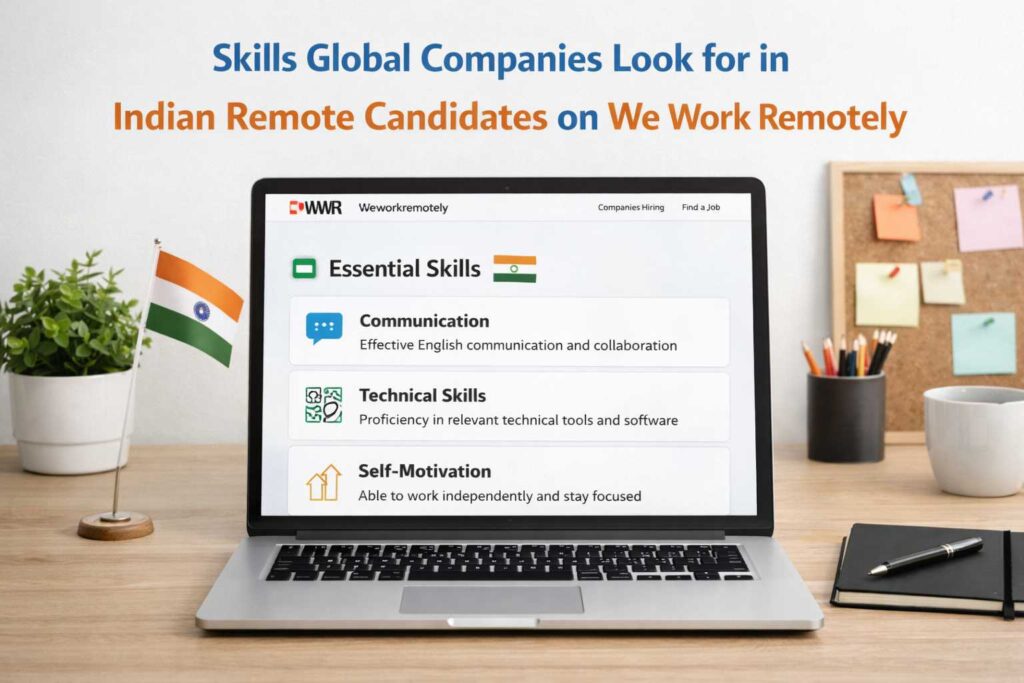
💡 Skills Global Companies Look for in Indian Remote Candidates on We Work Remotely
1. Strong Communication & English Proficiency
This is non-negotiable. Remote work relies entirely on written and verbal communication.
Global companies expect:
- Fluent, professional English (written and spoken)
- Clear email communication without errors
- Ability to explain technical concepts simply
- Comfortable on video calls without accent barriers
- Good documentation skills
- Respectful and professional tone in all communication
How to demonstrate:
- Write error-free cover letters and emails
- Have a portfolio website or GitHub with clear documentation
- Record a video introduction (some companies request this)
- Highlight international team experience
2. Time-Zone Awareness & Flexibility
Global companies work across multiple time zones. They value candidates who:
- Proactively suggest meeting times that work for everyone
- Are you willing to shift work hours for collaboration
- Clearly state their availability (e.g., “Available 6 PM–2 AM IST for US EST overlap”)
- Understand async communication necessity
- Don’t expect real-time responses in other time zones
How to demonstrate:
- In your cover letter, explicitly state time-zone flexibility
- Mention experience working across multiple time zones
- Show understanding of async communication practices
3. Experience with Remote Tools
Global companies use specific tools daily. Experience with these is essential:
Communication & Collaboration:
- Slack (primary communication tool)
- Zoom / Google Meet / Loom
- Asana / Linear / Monday.com (project management)
Development Tools:
- GitHub / GitLab
- Docker
- AWS / Google Cloud / Azure
- CI/CD systems (Jenkins, GitHub Actions, GitLab CI)
- Linux/Unix command line
Design Tools (if applicable):
- Figma
- Sketch
- Miro (design collaboration)
Productivity Tools:
- Notion
- Confluence
- Google Workspace
List these prominently on your resume and We Work Remotely profile.
4. Proven Work Samples or Portfolio
Global companies can’t meet you in person, so your portfolio is your proof. Provide:
- Developers: GitHub repositories with well-documented code, deployed projects with live links
- Designers: Behance, Dribbble, or personal portfolio showcasing 5-10 best works with case studies
- Writers: Published articles, blog posts, or writing samples
- Marketers: Case studies showing impact (traffic growth, conversion improvements, etc.)
- Product Managers: Examples of strategy documents, roadmaps, or product decisions you influenced
A strong portfolio can compensate for a lack of experience. A weak portfolio disqualifies even experienced candidates.
5. Remote Work Experience (If Possible)
Companies prefer candidates who have proven remote work success. If you have:
- Previous remote jobs
- Freelance experience
- Distributed team collaborations
- Open-source contributions
- Side projects built remotely
Highlight these prominently. They’re proof that you can work independently and asynchronously.
💰 Salary Expectations for Indians Working via We Work Remotely
Typical Salary Ranges by Role
| Role | We Work Remotely (USD/year) | Indian Market (₹ LPA) | Salary Multiple | INR Equivalent |
|---|---|---|---|---|
| Junior Software Engineer | $70,000–$100,000 | ₹8–12 | 6-8x | ₹57–82 lakhs |
| Senior Software Engineer | $140,000–$200,000 | ₹20–28 | 5-7x | ₹115–164 lakhs |
| DevOps Engineer | $110,000–$160,000 | ₹16–22 | 6-8x | ₹90–131 lakhs |
| Product Manager | $120,000–$180,000 | ₹18–25 | 5-8x | ₹98–148 lakhs |
| UX/UI Designer | $90,000–$140,000 | ₹10–15 | 6-9x | ₹74–115 lakhs |
| Content Writer | $50,000–$90,000 | ₹3–5 | 10-18x | ₹41–74 lakhs |
| Customer Success Manager | $70,000–$110,000 | ₹10–14 | 5-8x | ₹57–90 lakhs |
| Growth Marketer | $80,000–$140,000 | ₹10–16 | 5-9x | ₹66–115 lakhs |
Exchange rate assumed: ₹82 per USD. Variations based on experience, company size, funding stage, and specific skills. Data as of 2026.
Contract vs Full-Time Salary Structures
Full-Time Roles (Most Common on We Work Remotely):
- Salary paid monthly in USD
- Includes health insurance, 401(k), PTO
- Stable, long-term employment
- Easier visa sponsorship (if needed)
- Typical salary: $70,000–$200,000+ USD
Contract/Freelance Roles:
- Hourly or project-based rates
- No benefits; you handle taxes independently
- Usually $40–$150/hour for skilled professionals
- Flexibility but less stability
- Common for specialized or short-term projects
For Indians, full-time roles are preferable because they provide income stability and don’t require managing international tax obligations.
USD vs INR: The Real Advantage
A $100,000 USD salary = ₹82 lakhs annually = ₹68,333 monthly
In Bangalore, Mumbai, or Hyderabad, this is comfortable living with significant savings potential. In smaller Indian cities, it’s an exceptional wealth-building opportunity.
🎯 How to Increase Your Chances of Getting Hired on We Work Remotely
Resume and Portfolio Tips
Resume Best Practices:
- Highlight Remote Experience: Mention any remote roles, distributed teams, or async projects first
- Use Relevant Keywords: Include “Remote,” “Distributed Teams,” tool names (Slack, GitHub, Jira), programming languages, and frameworks
- Quantify Impact: “Reduced API response time by 45%” instead of “Optimized API.”
- Include Portfolio/GitHub: Always add links to your work
- Keep It Concise: 1-2 pages maximum; recruiters scan resumes in 6-10 seconds
- Use Professional Formatting: Clear sections, consistent fonts, good spacing
- Add Certifications: AWS, Google Cloud, Kubernetes, etc.
- Showcase Side Projects: Demonstrate initiative and continuous learning
Portfolio Best Practices (Critical for We Work Remotely):
- Developers: GitHub with 5-10 quality projects, well-commented code, deployed live versions with links, detailed README files
- Designers: 8-10 best works on Dribbble/Behance/personal site with case studies explaining your process
- Writers: 5-10 published articles or samples showing various writing styles
- Marketers: Case studies with metrics—”Grew organic traffic 150%,” “Improved conversion rate by 30%.”
Writing Strong Cover Letters for Global Companies
Structure (4 paragraphs, keep it under 200 words):
Paragraph 1: Express genuine interest and show you’ve researched the company.
Example: “I’m excited about the Senior Backend Engineer position at [Company]. Your approach to building scalable microservices aligns perfectly with my experience, and I’m impressed by your commitment to developer experience.”
Paragraph 2: Highlight 2-3 key achievements matching the job requirements.
Example: “In my previous role at [Company], I architected a Kafka-based real-time data pipeline, reducing data latency by 60% and enabling real-time personalization features that increased user engagement by 25%. I’m confident I can bring this expertise to your platform.”
Paragraph 3: Address remote work readiness explicitly.
Example: “I have 4+ years of experience working in fully distributed teams across US, EU, and APAC time zones. I’m comfortable overlapping with US business hours (6 PM–2 AM IST) and prefer async communication for deep work. I’m proficient with Slack, Zoom, and GitHub for remote collaboration.”
Paragraph 4: Call to action.
Example: “I’d love to discuss how I can contribute to [Company]. Thank you for considering my application.”
Standing Out as a Remote-Ready Candidate
- Write a Video Introduction: Some companies ask for short (2-3 minute) video introductions. Record yourself discussing why you’re interested and your relevant experience
- Create a Personal Blog: Document your learning, projects, and insights. Companies love seeing your thinking process
- Contribute to Open Source: Active GitHub contributions show you’re engaged with the community
- Build Side Projects: Demonstrate initiative by creating your own projects and shipping them
- Engage on Twitter/LinkedIn: Share insights about your field. It shows thought leadership
- Get Recommendations: Ask former managers or colleagues to recommend you on LinkedIn or provide written recommendations for your portfolio
⚠️ Common Mistakes Indian Applicants Should Avoid on We Work Remotely
1. Ignoring Job Location / Time-Zone Notes
Mistake: Applying for a role requiring “6 AM–2 PM PST” overlap when you can only work evenings.
Solution: Read time-zone requirements carefully. Only apply if you can genuinely meet their needs. In your cover letter, confirm your availability explicitly.
2. Sending Generic Applications
Mistake: Using the same cover letter for 20 different companies.
Solution: Customize every application. Mention the company name, show you understand their product/mission, and explain why you specifically want to work there. This takes 10 minutes but increases callbacks by 40-50%.
3. Not Showcasing Remote Experience
Mistake: Not mentioning previous remote work, distributed team experience, or async collaboration examples.
Solution: Prominently feature remote experience in your resume and cover letter. If you don’t have remote experience, mention side projects, open-source contributions, or freelance work you’ve managed independently.
4. Weak Portfolio or No Portfolio
Mistake: Applying without GitHub (for developers), Dribbble (for designers), or a portfolio website.
Solution: Create a portfolio today. Developers: push your best code to GitHub with documentation. Designers: upload work to Dribbble/Behance with case studies. Writers: create a simple portfolio website showing your writing.
5. Poor Resume Formatting and Grammar
Mistake: Resume with spelling errors, inconsistent formatting, or vague descriptions.
Solution: Proofread 3 times. Use tools like Grammarly. Format consistently. Save as PDF. Have a native English speaker review it if possible.
6. Applying Without Researching the Company
Mistake: Applying and mentioning in your cover letter that you “look forward to working with this innovative tech company” without knowing what they actually do.
Solution: Research thoroughly. Visit their website, read about their product, check their funding, and understand their mission. Reference something specific in your cover letter.
7. Underpricing Your Skills or Asking Too High
Mistake: Accepting $40,000 for a senior role worth $120,000, or demanding $200,000 when you’re entry-level.
Solution: Research salary ranges on Glassdoor and We Work Remotely job boards. Know your market value. Negotiate confidently but reasonably. If salary is flexible, respond with a range.
8. Not Following Application Instructions
Mistake: Ignoring specific instructions like “Answer the 3 screening questions” or “Include your GitHub link.”
Solution: Read instructions carefully. Follow every request. Companies notice when you pay attention to details.
9. Ignoring Hiring Manager Messages
Mistake: Missing emails or messages from hiring managers because you don’t check your email regularly.
Solution: Check email daily during job search. Respond to recruiter messages within 24 hours. Missing a message can cost you the opportunity.
10. Not Following Up
Mistake: Applying and never following up, assuming no response means rejection.
Solution: After 2 weeks, send a polite follow-up email: “Hi [Name], I applied for the [Role] position on [Date]. I remain very interested. Do you have an update on the timeline?”
🚀 Conclusion: We Work Remotely is Your Ticket to Global Success
We Work Remotely represents a fundamental shift in how work happens. For Indian professionals, it’s not just a job board—it’s a gateway to international careers, competitive salaries, and global work culture without leaving home.
The platform’s focus on 100% remote roles, commitment to quality, and concentration of forward-thinking companies creates an unparalleled opportunity. Every job on We Work Remotely is explicitly designed for remote work, meaning no surprises about location, no office politics, and no geographic limitations on your earning potential.
The salary differential is real and life-changing. A $100,000 USD remote role translates to ₹82 lakhs annually—5-6x more than equivalent positions in India. Over a 5-10 year career, this compounds into a massive wealth-building opportunity.
Success on We Work Remotely requires strategy: build an outstanding portfolio, craft personalized applications, emphasize remote work readiness, and demonstrate global communication skills. But the reward—a meaningful, flexible, high-paying international career—is absolutely worth the effort.
The global talent economy is open. We Work Remotely is where the best remote opportunities live. Indian talent is in high demand worldwide. The only question is: are you ready to make your move?
Start today: Visit We Work Remotely, explore categories matching your skills, update your portfolio, and apply to roles that excite you. Your international remote career awaits in 2026.
Website: www.weworkremotely.com