

🎯 Introduction: What is HackerRank Jobs?
HackerRank Jobs is a skill-based hiring platform where companies recruit developers through coding challenges, technical assessments, and real-world problem-solving—not traditional resume screening. Founded on the principle that coding ability matters more than resume credentials, HackerRank Jobs connects talented developers directly with employers seeking technical expertise.
Unlike traditional job boards, where resumes are filtered by algorithms, HackerRank Jobs inverts the hiring model. Companies post coding challenges and technical assessments. Developers solve these challenges. Companies evaluate your actual coding ability, not your resume. Top performers get contacted by companies with job offers.
For Indian developers, this is transformative. HackerRank eliminates resume bias. A developer from a tier-3 college who can solve complex algorithms is valued equally with someone from IIT. Your coding ability is your currency. This meritocratic approach has created massive opportunities for Indian talent to access international roles.
HackerRank Jobs hosts thousands of active hiring challenges from tech companies worldwide. Developers who practice consistently and develop strong problem-solving skills can attract multiple job offers from global companies—all for remote positions paying international salaries.
✨ Why HackerRank Jobs is Ideal for Indian Developers
1. Skill-First Hiring (Less Resume Bias)
This is HackerRank’s core differentiator. Traditional hiring favours:
- Brand-name colleges (IIT, Delhi University, etc.)
- Work experience at recognised companies
- Perfect resume formatting
- Right connections
HackerRank Jobs ignores all of that. What matters:
- Your Coding Ability: Can you solve algorithms efficiently?
- Problem-Solving: Can you approach novel problems systematically?
- Code Quality: Is your code clean, readable, and optimised?
- Speed: Can you code quickly without mistakes?
A developer from a tier-3 college who consistently solves hard problems will get more offers than someone from IIT with a mediocre coding ability. This meritocratic approach eliminates the resume bias that disadvantages many Indian developers.
2. Opportunities with Global Companies
HackerRank attracts serious global companies:
- US Tech Companies: Google, Amazon, Microsoft, Meta, Stripe
- Series-A to Series-D Startups: Well-funded, growth-stage companies
- European Companies: UK, Germany, France, Netherlands tech firms
- International Scale-ups: Singapore, Australia, Canada companies
- Fortune 500 Companies: Global enterprises needing engineering talent
These companies are hiring because they need developers, not to fill recruitment quotas. They have real budgets and serious positions. The competition is global, but so is the opportunity pool.
3. Remote and International Tech Roles
HackerRank Jobs focuses on remote and international positions:
- Fully Remote: 100% work-from-home roles
- International Salaries: USD-based compensation (5-8x Indian market)
- No Relocation: Work from India for global companies
- Global Teams: Collaborate across time zones
- Flexible Arrangements: Many roles accommodate Indian time zones
For Indian developers, this means unlimited opportunity. You’re not competing for the 100 remote jobs in India. You’re accessing 10,000+ remote jobs globally.
4. Strong Demand for Indian Engineering Talent
Indian developers are highly sought after on HackerRank:
- Cost-Effective Quality: Excellent technical skills at a reasonable cost
- Time-Zone Advantage: Indian developers can cover APAC and overlap with the US/EU
- English Proficiency: Strong communication skills valued globally
- Reliability: Indian developers are known for commitment and quality
- Cultural Fit: Many companies have Indian founders and teams
Companies actively seek Indian talent on HackerRank because they know the quality and reliability are exceptional.
💼 Types of Remote Jobs Available via HackerRank Jobs
1. Software Engineer / Developer (Various Specialisations)
General software engineer roles across different domains.
Common positions:
- Junior Software Engineer
- Software Engineer
- Senior Software Engineer
- Staff Engineer
- Software Architect
- Engineering Manager
Salary Range: $80,000–$250,000+ USD
Why Popular: Highest demand globally; HackerRank’s core market; diverse specialisations available.
2. Backend & Full-Stack Developer
Backend and full-stack development roles (largest category).
Common positions:
- Backend Engineer (Python, Java, Node.js, Go)
- Full-Stack Engineer
- Backend Architect
- Senior Backend Engineer
- Distributed Systems Engineer
- Microservices Specialist
Salary Range: $90,000–$280,000+ USD
Why Popular: Highest demand; best compensation; most HackerRank challenges focus on backend skills.
3. Frontend Engineer
Frontend-specific roles (growing category).
Common positions:
- Frontend Engineer (React, Vue, Angular)
- Senior Frontend Engineer
- Frontend Architect
- UI Engineer
- Web Performance Engineer
- Frontend Tech Lead
Salary Range: $80,000–$240,000+ USD
Why Popular: Growing demand; complex problem-solving; system-level thinking required.
4. Data Engineer & Data Scientist
Data-focused roles with premium compensation.
Common positions:
- Data Engineer
- Data Scientist
- Machine Learning Engineer
- Analytics Engineer
- Big Data Engineer
- Data Architect
Salary Range: $100,000–$300,000+ USD
Why Popular: Data science premium salaries; complex algorithms; strategic importance; scarcity of talent.
5. QA / Automation Engineer
Quality assurance and test automation roles.
Common positions:
- QA Automation Engineer
- Test Automation Specialist
- QA Engineer
- Performance Testing Specialist
- Test Architecture
Salary Range: $70,000–$200,000+ USD
Why Popular: Quality critical for products; automation increasingly important; growing specialisation.
6. DevOps & Cloud Engineer
Infrastructure and cloud roles (specialised, premium pay).
Common positions:
- DevOps Engineer / SRE
- Cloud Engineer (AWS, GCP, Azure)
- Infrastructure Engineer
- Cloud Architect
- Platform Engineer
- System Administrator
Salary Range: $100,000–$280,000+ USD
Why Popular: Specialised skills command a premium; critical for operations; architectural opportunities.
🚀 How Indian Developers Can Get Hired on HackerRank Jobs: Step-by-Step
Step 1: Create Your HackerRank Account
Go to www.hackerrank.com/jobs. Click “Sign Up” as a Developer. Provide:
- Email address
- Password
- Name
- Phone number
Or sign up using a Google/GitHub account.
Step 2: Complete Your Developer Profile
Your profile is critical. Complete every section:
Profile Information:
- Professional photo
- Full name
- Current location (India/city)
- Years of experience
- Open to work (toggle ON)
Skills & Expertise:
- Primary specialisation (Backend, Frontend, Data, DevOps, etc.)
- Programming languages (with proficiency level)
- Frameworks and tools
- Databases
- Cloud platforms
- Years of experience in each
Work History:
- Current company and role
- Previous roles and companies
- Key achievements
- Technologies used
- Duration and responsibilities
Resume & Portfolio:
- Upload resume (PDF)
- GitHub profile link (essential for developers)
- Personal website or portfolio
- LinkedIn profile
Job Preferences:
- Desired job type (Full-Time, Contract, Both)
- Salary expectations (USD)
- Preferred location (Remote)
- Industries of interest
- Willing to relocate (No, if working from India)
A complete profile increases visibility to companies and gets you automatic job recommendations.
Step 3: Practice and Pass Coding Challenges
This is where you prove your skills:
HackerRank Practice:
- Go to HackerRank Practice section (free)
- Start with “Easy” problems (warm-up)
- Progress to “Medium” (most common in interviews)
- Advance to “Hard” (for senior roles)
- Practice consistently (30 min–1 hour daily minimum)
Focus Areas:
- Arrays & Strings: Manipulation, searching, sorting
- Linked Lists: Traversal, insertion, deletion
- Stacks & Queues: LIFO/FIFO concepts
- Trees & Graphs: Traversal, shortest path, DFS/BFS
- Dynamic Programming: Optimisation problems
- Hashing: Hash maps and sets
- Sorting & Searching: Efficiency and optimisation
- SQL: Database queries (if applying for data roles)
Time Target: Solve at least 50 medium-level problems before applying to company challenges.
Step 4: Get Shortlisted by Companies
Companies post coding challenges on HackerRank:
- Browse Job Postings: See companies with open positions
- Review Requirements: Read job description and challenges
- Take Assessment: Complete the company’s coding test (usually 1-3 hours)
- Solve Problems: Demonstrate your problem-solving ability
- Get Ranked: Your solution is evaluated against others
- Get Shortlisted: Top performers are invited for interviews
Your ranking is based on:
- Correctness: All test cases pass
- Efficiency: Time and space complexity
- Code Quality: Readability, maintainability
- Speed: How quickly you solved it
Step 5: Interview and Remote Hiring Process
After being shortlisted:
- Initial Screening (Optional): Brief conversation with recruiter
- Technical Interview(s) (1-3 rounds):
- Live coding interview
- System design (for senior roles)
- Data structures and algorithms
- Manager/Culture Interview: Meet your future team
- Offer: Formal offer with salary, benefits, and start date
- Background Check: Standard verification
- Onboarding: Remote setup and team integration
Timeline: 2-4 weeks from being shortlisted to offer.
💡 Most In-Demand Skills & Programming Languages
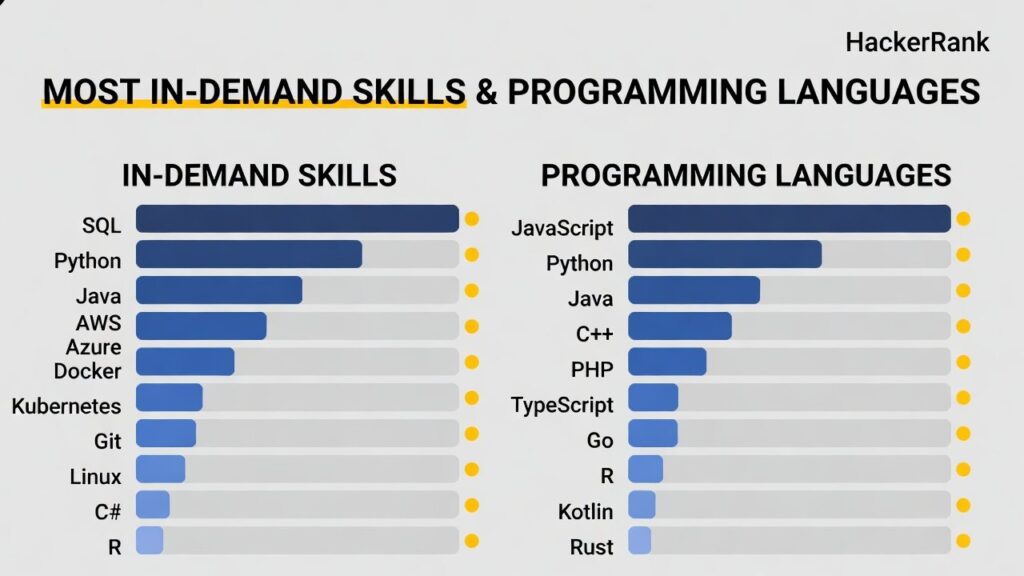
Top Programming Languages on HackerRank Jobs
- Python – Most versatile; used in backend, data science, automation
- JavaScript – Web development, full-stack roles
- Java – Enterprise systems, large-scale applications
- C++ – Performance-critical systems, finance, gaming
- Go – Cloud infrastructure, microservices, backend
- Rust – Systems programming, growing demand
- TypeScript – Strong typing for JavaScript
- SQL – Universal database skill
- C# – Enterprise, .NET applications
- Kotlin – Android development
Data Structures & Algorithms (Most Important)
HackerRank assessments heavily focus on:
- Arrays & Strings: Basic problem-solving foundation
- Hash Tables/Maps: Optimize search operations
- Linked Lists: Data structure fundamentals
- Stacks & Queues: Problem-solving patterns
- Trees & Graphs: Complex problem-solving
- Sorting: O(n log n) optimization
- Searching: Binary search, depth-first, breadth-first
- Dynamic Programming: Hard problems, optimisation
- Greedy Algorithms: Optimisation strategies
- Recursion: Problem decomposition
Complexity Analysis: Understanding Big O notation is critical. Interviewers want O(n) or O(n log n) solutions, not O(n²).
System Design Basics (For Senior Roles)
If applying for senior positions:
- Scalability: Design systems handling millions of users
- Databases: SQL vs NoSQL trade-offs
- Caching: Redis, Memcached for performance
- Message Queues: Kafka, RabbitMQ for async processing
- Microservices: System architecture
- Load Balancing: Handling traffic distribution
- Monitoring & Logging: System observability
SQL and Problem-Solving Skills
- SQL Queries: Joins, aggregations, subqueries
- Problem Analysis: Breaking down complex problems
- Optimisation: Finding efficient solutions
- Testing: Edge cases and error handling
💰 Salary Expectations for Indian Developers
International Remote Salary Ranges (USD)
| Role | Junior (USD) | Mid-Level (USD) | Senior (USD) | Staff (USD) |
|---|---|---|---|---|
| Backend Engineer | $80K–$120K | $130K–$180K | $180K–$270K | $250K–$400K+ |
| Frontend Engineer | $75K–$115K | $120K–$170K | $170K–$250K | $230K–$380K+ |
| Full-Stack Engineer | $80K–$120K | $130K–$180K | $180K–$270K | $240K–$380K+ |
| Data Engineer | $90K–$130K | $140K–$200K | $200K–$300K | $280K–$450K+ |
| Data Scientist | $100K–$150K | $150K–$220K | $220K–$320K | $300K–$500K+ |
| DevOps Engineer | $85K–$125K | $130K–$190K | $190K–$280K | $260K–$420K+ |
| QA/Automation | $70K–$100K | $110K–$160K | $160K–$240K | $220K–$350K+ |
Exchange rate assumed: ₹82 per USD. Salaries vary by company funding, experience, and specialisation. Data as of 2026.
Comparison: HackerRank Jobs Salaries vs India-Based Tech
| Role | HackerRank (USD) | India (₹ LPA) | Salary Multiple | INR Equivalent |
|---|---|---|---|---|
| Mid Backend | $155K | ₹20–28 | 5-7x | ₹127 lakhs |
| Senior Backend | $220K | ₹28–40 | 5-7x | ₹180 lakhs |
| Senior Full-Stack | $240K | ₹28–40 | 5-7x | ₹197 lakhs |
| Data Engineer | $210K | ₹24–32 | 5-8x | ₹172 lakhs |
| Data Scientist | $260K | ₹28–40 | 5-7x | ₹213 lakhs |
Key Takeaway: HackerRank Jobs salaries are 5-8x higher than Indian market rates for equivalent roles and experience levels.
Contract vs Full-Time Roles
Full-Time (Recommended for Indians):
- Monthly salary in USD
- Health insurance
- Retirement benefits (401k)
- PTO and paid holidays
- Professional development budget
- Equity options (many companies)
Contract (Less Stable):
- Hourly or project-based rates
- No benefits (you manage)
- Flexibility and variety
- Often a higher hourly rate to offset the lack of benefits
For Indian developers, full-time remote roles provide better stability and tax simplicity.
📚 How to Prepare for HackerRank Assessments
Daily Practice Strategy
Beginner (0-100 Problems):
- Start with Easy problems (warm-up)
- 1-2 easy problems daily (15-30 min)
- Focus on understanding concepts
- Learn new data structures weekly
Intermediate (100-250 Problems):
- Solve 2-3 Medium problems daily (45-90 min)
- Understand optimal solutions
- Analyse time/space complexity
- Recognize problem patterns
Advanced (250+ Problems):
- Solve 1-2 Hard problems daily (90-120 min)
- Focus on novel approaches
- Study advanced topics (DP, graphs)
- Optimise for speed
Total Practice Timeline: 3-6 months to be interview-ready.
Common Challenge Types
Strings & Arrays:
- Anagrams, palindromes, substrings
- Two-pointer techniques
- Sliding window problems
Data Structures:
- Linked list manipulation
- Tree traversals
- Graph shortest paths
Algorithms:
- Sorting optimization
- Search algorithms
- Dynamic programming
- Greedy solutions
SQL Challenges:
- Complex joins
- Aggregations
- Window functions
Real-World Problems:
- Design patterns
- System optimization
- Code refactoring
Time-Management Tips During Tests
During Assessment (Usually 1-3 Hours):
- Read Carefully (5 min): Understand the problem completely
- Plan Approach (10 min): Pseudocode or outline your solution
- Code (40 min for medium): Implement solution cleanly
- Test (5 min): Run through test cases
- Optimise (Optional): If time allows, improve complexity
Speed Tips:
- Avoid overthinking—start coding quickly
- Use template code for common patterns
- Type fast (practice typing speed)
- Don’t debug extensively—code carefully the first time
- Test cases as you code, not after
⚠️ Common Mistakes Indian Developers Should Avoid
1. Skipping Practice
Mistake: Applying to company challenges without practicing basics.
Solution: Solve 50+ problems on HackerRank practice before applying to company assessments. Practice is non-negotiable.
2. Ignoring System Design Fundamentals
Mistake: Only practising algorithms; neglecting system design for senior roles.
Solution: For mid/senior roles, study system design. Learn about scalability, databases, and distributed systems.
3. Weak Profile Descriptions
Mistake: Vague bio, missing GitHub, no project examples.
Solution: Write a compelling bio highlighting specialisation. Add GitHub with quality projects. Show actual work.
4. Poor Code Quality
Mistake: Code that passes tests but is unreadable or inefficient.
Solution: Write clean code. Add comments. Optimise for both time and space. Prioritise readability.
5. Time Management During Tests
Mistake: Spending 80% of the time on one problem, rushing the others.
Solution: Allocate time evenly. Skip hard problems if stuck; come back later.
6. Not Reading Problem Statements Carefully
Mistake: Misunderstanding requirements and solving the wrong problem.
Solution: Read 2-3 times. Clarify all edge cases mentally before coding.
7. Ignoring Edge Cases
Mistake: Code works for the happy path but fails on edge cases.
Solution: Think about: empty inputs, single elements, duplicates, negative numbers, etc.
8. Overcomplicating Solutions
Mistake: Complex approaches when simple solutions exist.
Solution: Start simple. Optimise only if needed. Sometimes brute force is acceptable.
9. Not Learning From Failures
Mistake: Failing a challenge and not understanding why.
Solution: After each challenge, review wrong answers. Understand optimal solutions. Learn patterns.
10. Weak English Communication
Mistake: Poor communication during technical interviews.
Solution: Practice explaining your approach clearly. Improve English. Record yourself and critique.
🤔 HackerRank Jobs vs Traditional Job Portals
| Aspect | HackerRank Jobs | Naukri | Turing | |
|---|---|---|---|---|
| Hiring Model | Skill-based challenges | Resume + interviews | Resume screening | Full vetting + assessment |
| Resume Bias | Minimal (skills-first) | High (resume matters) | High (resume critical) | Medium (vetting reduces bias) |
| Job Volume | Growing (thousands) | Excellent | Excellent | Limited (quality) |
| International Opportunity | Excellent | Excellent | Limited | Excellent |
| Salary Level | $80K–$300K+ | Varies widely | ₹10–40 LPA | $100K–$300K+ |
| Skill Assessment | Rigorous (coding tests) | Optional | None | Rigorous |
| Best For | Developers proving skills | Broad searches | Indian jobs | Full-time seekers |
| Time to Job | 2-4 weeks | 1-4 weeks | 1-2 weeks | 2-4 weeks |
| Fairness Factor | Most fair (meritocratic) | Resume-biased | Resume-biased | Fair (assessed) |
Verdict:
- Choose HackerRank if: You want to prove your skills objectively and compete on merit
- Choose LinkedIn if: You want maximum visibility and broad opportunities
- Choose Naukri if: You’re seeking India-based positions
- Choose Turing if: You want vetting alongside skill assessment
🎯 Conclusion: Skill-Based Hiring Changes Everything for Indian Developers
HackerRank Jobs represents a fundamental shift in how tech talent is evaluated. For Indian developers, this is liberating. Your college name doesn’t matter. Your resume pedigree is irrelevant. Only your coding ability matters.
This meritocratic approach has created massive opportunities for Indian talent. Developers from tier-3 colleges who practice relentlessly now get offers from Fortune 500 companies, beating IIT graduates with mediocre coding skills. This is revolutionary.
The path is clear and achievable: Practice consistently on HackerRank (30 min–1 hour daily). Solve at least 50 medium-level problems. Build a strong GitHub portfolio. Create a compelling profile. Then apply to the company challenges. Companies will evaluate your skills objectively and make offers accordingly.
The numbers justify the effort. A developer earning $150,000 on HackerRank = ₹123 lakhs annually. That’s 6x the Indian market rate for equivalent experience. Over a decade, that’s ₹23+ crores you’d make—versus ₹3-4 crores in India. The wealth-building potential is exceptional.
Thousands of Indian developers have walked this path. They practised coding challenges, got shortlisted by global companies, and landed six-figure international roles—all while working from India. Your success story could be next.
Start today: Create your HackerRank account, start practising daily, and commit to solving 50+ problems. Your skill-based international career awaits.
Website: www.hackerrank.com/jobs