

Introduction: What is GitHub Jobs?
GitHub Jobs is a specialized job board exclusively for software developers, engineered by GitHub itself to connect talented engineers with forward-thinking companies. Unlike generic job platforms, GitHub Jobs operates within the GitHub ecosystem, allowing employers to evaluate candidates based on actual coding ability, project history, and contributions to open-source communities rather than degrees or certifications alone.
For Indian software developers, GitHub Jobs represents a fundamental shift in how they can access international employment opportunities. Instead of competing on paper credentials, you compete on demonstrated technical expertise—your repositories, pull requests, code quality, and real-world problem-solving ability. Companies posting on GitHub Jobs include Fortune 500 tech firms, well-funded startups, and innovative scale-ups actively hiring remote developers across every technology stack.
The platform aggregates job listings from companies that value skill-based hiring, making it an invaluable resource for developers in India looking to work with global tech teams from home.
Why GitHub Jobs is Valuable for Indian Developers
Skill-Based Hiring Over Traditional Credentials
The traditional hiring process often disadvantages talented developers from India. Recruiters prioritize degrees from Ivy League universities, certifications from expensive training institutes, or work experience at recognizable multinational corporations. GitHub Jobs flips this narrative entirely.
When you apply for a position on GitHub Jobs, hiring managers examine your GitHub profile first. They review your code quality, architectural decisions, how you handle code reviews, and whether you’ve shipped production-ready features. A self-taught developer with 20 impressive open-source contributions often has a stronger application than a graduate from a prestigious university with an empty GitHub profile.
This meritocratic approach has empowered thousands of Indian developers to secure roles at companies they would have otherwise struggled to access through traditional recruitment channels.
Strong Preference for Open-Source Contributors
Companies hiring through GitHub Jobs place significant weight on open-source contributions. When you contribute to popular repositories—whether fixing bugs, adding features, or improving documentation—you provide employers with concrete evidence of collaboration, code quality, and your ability to work within established development workflows.
For Indian developers, open-source contribution is one of the most direct paths to international employment. Contributing to projects like Kubernetes, React, TensorFlow, or even smaller but well-maintained libraries demonstrates that you can write production-grade code and collaborate with distributed teams—exactly what global tech companies need.
Remote and International Opportunities
GitHub Jobs specializes in remote positions. Most listings explicitly advertise “Remote – Worldwide” or “Remote – India eligible,” eliminating geographic barriers that plague traditional job boards. You can work for a San Francisco startup, a Berlin-based fintech company, or a Toronto product studio—all from your home in Bangalore, Mumbai, Delhi, or Pune.
The remote-first nature of GitHub Jobs is crucial for Indian developers because it means competing on level ground. Your timezone difference becomes a feature (you provide 24-hour coverage for global teams), not a liability. Employers actively seeking remote developers understand the value of distributed teams and build company culture accordingly.
High Trust from Global Tech Companies
GitHub Jobs attracts employers who understand developer ecosystems deeply. These companies aren’t posting generic “we need 50 developers” listings. They’re looking for specific skill sets and are willing to hire from anywhere globally if the candidate demonstrates competence.
The trust placed in the GitHub platform by companies like Stripe, GitLab, Shopify, and thousands of others means the quality of job listings is significantly higher than on generic job boards. When you see a position on GitHub Jobs, it’s more likely to be a legitimate, well-funded role with competitive compensation than on other platforms.
Best Remote Job Roles on GitHub Jobs for Indians
Software Engineer / Developer
This is the broadest category on GitHub Jobs, encompassing generalist developers who work across multiple layers of the technology stack. These roles are ideal if you’re skilled in multiple programming languages and frameworks and enjoy working on diverse problems.
What employers look for: Experience building scalable systems, familiarity with modern development practices, and portfolio projects demonstrating end-to-end development capability. A strong candidate might have maintained a SaaS application, contributed to multiple large codebases, and demonstrated the ability to learn new technologies quickly.
Compensation for Indian developers: $60,000–$130,000 USD annually, depending on seniority and the company’s location.
Frontend Developer
Frontend development is particularly hot on GitHub Jobs, with hundreds of remote positions available at any given time. Companies need developers who understand modern JavaScript frameworks, responsive design, web performance, and user experience principles.
What employers look for: Mastery of React, Vue.js, or Angular; understanding of CSS and design systems; experience with frontend testing frameworks; and ability to optimize web application performance. Your GitHub profile should showcase well-designed, responsive applications with clean code and thoughtful UI/UX decisions.
Compensation for Indian developers: $55,000–$120,000 USD annually.
Backend Developer
Backend development remains one of the most in-demand categories. Companies need developers who can architect databases, design APIs, handle concurrency, and ensure system reliability and scalability.
What employers look for: Proficiency in languages like Python, Java, Go, or JavaScript/Node.js; experience with databases (SQL and NoSQL); understanding of microservices architecture; and familiarity with containerization (Docker, Kubernetes). Backend developers should demonstrate experience building systems that scale.
Compensation for Indian developers: $60,000–$135,000 USD annually.
Full-Stack Developer
Full-stack positions combine frontend and backend responsibilities. These roles are ideal for developers comfortable across the entire technology stack and prefer wearing multiple hats.
What employers look for: Solid understanding of both frontend frameworks and backend architecture; experience with deployment, DevOps basics, and databases; and ability to own features from database design to user interface. Full-stack developers often become technical leads in startups.
Compensation for Indian developers: $65,000–$140,000 USD annually.
DevOps & Cloud Engineer
As companies migrate to cloud infrastructure, DevOps engineers are increasingly in demand on GitHub Jobs. These roles focus on infrastructure, deployment pipelines, monitoring, and system reliability.
What employers look for: Deep knowledge of cloud platforms (AWS, Google Cloud, Azure); expertise with containerization and orchestration (Docker, Kubernetes); experience with CI/CD pipelines; and understanding of infrastructure-as-code. DevOps engineers with strong coding skills are particularly valuable.
Compensation for Indian developers: $70,000–$145,000 USD annually.
Data Engineer & Data Scientist
With the explosion of data-driven products, data roles are abundant on GitHub Jobs. Data engineers focus on building data pipelines and infrastructure, while data scientists develop machine learning models and analytics solutions.
What employers look for: For data engineers: proficiency with Python, SQL, and big data tools (Spark, Hadoop); experience building ETL pipelines; and understanding of data warehousing. For data scientists: strong mathematics background, machine learning framework expertise (TensorFlow, PyTorch, scikit-learn), and ability to translate business problems into data solutions.
Compensation for Indian developers: $70,000–$150,000 USD annually (premium for specialists).
Mobile App Developer
Mobile development positions on GitHub Jobs span iOS (Swift), Android (Kotlin, Java), and cross-platform frameworks (React Native, Flutter). These roles are perfect for developers who enjoy building user-facing applications.
What employers look for: Proficiency in platform-specific languages and frameworks; understanding of mobile-specific performance constraints; experience with mobile app deployment (App Store, Google Play); and ability to design intuitive mobile interfaces. Portfolio projects demonstrating published apps are highly valuable.
Compensation for Indian developers: $55,000–$120,000 USD annually.
Open-Source Maintainer Roles
Some companies hire developers explicitly to maintain and enhance open-source projects they rely on or sponsor. These specialized roles suit developers who are already active in open-source communities.
What employers look for: Track record as an open-source contributor or maintainer; ability to manage community interactions; experience with version control workflows; and commitment to code quality and documentation. These roles are relatively rare but highly prestigious.
Compensation for Indian developers: $80,000–$160,000 USD annually (varies widely based on project importance).
How Indian Developers Can Get Jobs via GitHub Jobs: Step-by-Step Strategy
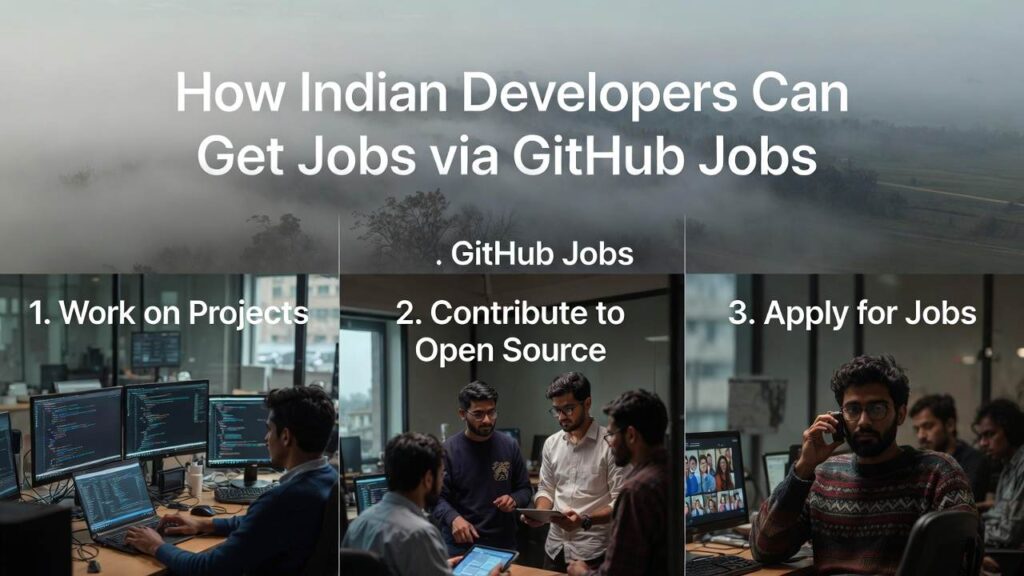
Step 1: Build a Professional GitHub Profile
Your GitHub profile is your resume. Start by ensuring it’s complete and professional:
- Write a detailed profile bio explaining your technical interests and expertise
- Add a profile picture (professional headshot or avatar)
- Pin your best projects to your profile homepage
- Ensure your profile URL is clean and easy to share
Think of your GitHub profile as a living portfolio. Every project you publish, every contribution you make, and every repository you maintain builds your public technical reputation.
Step 2: Create High-Quality Repositories
Don’t just maintain private projects. Build projects specifically for public display:
- Build a SaaS project from scratch demonstrating full-stack capability
- Create a reusable library or tool that solves a real problem
- Contribute to tools you use daily in your work
Each repository should have:
- A comprehensive README.md explaining the project, how to install it, and how to use it
- Clean, well-commented code
- A working example or demo link
- License information
Quality matters far more than quantity. One well-maintained project impresses employers more than 50 abandoned repositories.
Step 3: Contribute to Popular Open-Source Projects
Open-source contributions demonstrate that you can work within established codebases and collaborate with community members:
- Start with projects using technologies you know well
- Begin with documentation improvements or small bug fixes
- Graduate to implementing requested features
- Maintain consistent contributions (even small ones count)
Projects like First Timers Only, Good First Issue, and Awesome for Beginners help identify entry points for new contributors. Consistency matters more than volume—employers prefer to see regular contributions over months rather than one-time submissions.
Step 4: Search GitHub Jobs Strategically
GitHub Jobs allows filtering by several criteria:
- Technology/Language: Search for roles requiring skills you possess or want to develop
- Location: Filter for “Remote” positions
- Experience Level: Choose entry-level, mid-level, or senior roles based on your experience
- Company: Some developers target specific companies they admire
Save searches for your primary tech stack and check GitHub Jobs regularly (ideally daily). Set up email notifications if available, or bookmark your filtered searches.
Step 5: Apply Through Company Career Pages
Most GitHub Jobs listings include direct links to company career pages or application systems. When applying:
- Customize your cover letter for each position
- Explicitly reference relevant projects from your GitHub profile
- Link directly to your GitHub profile and specific repositories
- Explain how your open-source work relates to the role
- Highlight any contributions to tools the company uses
A personalized application with specific references to your GitHub work dramatically increases your chances of interview callbacks.
Step 6: Prepare for Technical Interviews
After applying, prepare for technical rounds that typically include:
- Coding interviews: Problems testing algorithm knowledge and problem-solving
- System design interviews: Questions about architecture and scalability
- Take-home projects: Real-world coding assignments
- GitHub review: Discussion of your open-source contributions
Platforms like LeetCode and HackerRank help prepare for algorithm questions, while books like “Designing Data-Intensive Applications” prepare for system design rounds.
Skills & Technologies Employers Look For
Programming Languages
Demand varies by role, but several languages consistently top employer wish lists:
Python remains the most versatile language, dominating in backend development, data science, and DevOps. Its readability and extensive libraries make it ideal for startups and large tech companies alike.
JavaScript/TypeScript is essential for frontend development and increasingly used in backend development (Node.js) and full-stack roles. TypeScript adoption is growing rapidly among serious development shops.
Go (Golang) is increasingly sought for systems programming, microservices, and DevOps. Companies building cloud infrastructure and scalable services often prefer Go for its performance and concurrency model.
Java remains dominant in enterprise environments and large-scale systems. Strong Java skills open doors at established tech companies and financial institutions.
Rust is gaining traction among companies prioritizing performance, memory safety, and systems-level programming. Learning Rust signals serious engineering interest.
Frameworks & Tools
Beyond core languages, employers evaluate framework expertise:
- Frontend: React, Vue.js, Next.js, Angular, Svelte
- Backend: Django, FastAPI, Express.js, Spring Boot, Gin
- Data: TensorFlow, PyTorch, scikit-learn, Apache Spark
- DevOps: Kubernetes, Docker, Terraform, Jenkins
Version Control & Collaboration
Mastery of Git is non-negotiable. Employers examine not just your ability to use Git, but your understanding of professional workflows:
- Feature branch workflows
- Pull request culture and code review participation
- Commit message clarity
- Rebase vs. merge decision-making
Active participation in code reviews—whether giving thoughtful feedback on others’ work or responding constructively to feedback—demonstrates professional maturity.
Clean Code & Documentation
Code quality matters as much as functionality. Employers look for:
- Self-documenting code with clear variable and function names
- Appropriate comments explaining complex logic
- Proper error handling and validation
- Tests demonstrating that code works as intended
- Documentation explaining how to use your code
Salary Expectations for Indian Developers
USD-Based Remote Salaries
Remote positions on GitHub Jobs are typically quoted in USD, reflecting global rates rather than India-adjusted salaries:
Entry-Level (0–2 years experience): $40,000–$70,000 USD annually
- Role types: Junior developer, graduate developer, internship-to-hire positions
- Typical location: Startups, smaller companies, or first international role
Mid-Level (2–5 years experience): $70,000–$120,000 USD annually
- Role types: Full software engineer, specialized developer (frontend/backend/DevOps)
- Typical employers: Growth-stage startups, established tech companies
Senior-Level (5+ years experience): $120,000–$200,000+ USD annually
- Role types: Senior engineer, architect, tech lead
- Typical employers: FAANG companies, well-funded startups, high-growth scale-ups
Staff/Principal-Level (10+ years experience): $180,000–$300,000+ USD annually
- Role types: Staff engineer, principal engineer, architect
- Typical employers: Major tech companies, specialized firms
Contract vs. Full-Time Roles
GitHub Jobs lists both full-time employment and contract positions:
Full-Time Roles typically offer salary, health insurance (where applicable), paid time off, and equity in startups. Full-time positions provide stability and long-term benefits.
Contract/Freelance Roles offer higher hourly or project-based rates but no benefits. Contract rates often range from $60–$150+ per hour depending on experience and specialization.
For Indian developers, full-time remote employment often provides better work-life balance and income stability than contract work, though both paths can be lucrative.
Comparison with India-Based Salaries
To contextualize these figures: an Indian software engineer with 3 years of experience typically earns ₹8–15 lakhs ($9,600–$18,000 USD) annually in India. A remote position paying $90,000 USD represents a 5–10x income increase, enabling financial security and family support in ways domestic employment rarely provides.
After accounting for taxes, currency conversion, and healthcare costs, a $100,000 USD remote job remains substantially more lucrative than equivalent positions in India.
How to Stand Out as an Indian Developer
Build a Public Portfolio of Work
Rather than a traditional resume, your GitHub profile IS your portfolio. Employers evaluate you through the lens of your public work:
- Create projects that solve real problems, not toy examples
- Build applications you’d actually use yourself
- Maintain consistency: regular commits and updates matter
- Show evolution: projects improving over time demonstrate learning
A portfolio showing growth from simple CLI tools to complex full-stack applications tells a compelling story.
Master Open-Source Contribution
Open-source contribution is one of the most direct paths to international employment for Indian developers:
- Fix bugs in projects you use
- Improve documentation
- Implement requested features from issue trackers
- Engage respectfully with maintainers and community members
Consistent, quality contributions demonstrate professionalism and collaborative ability better than anything else.
Write Clear Documentation
Many developers underestimate documentation’s importance. Employers notice when your projects include:
- Comprehensive README files explaining purpose, installation, and usage
- API documentation for libraries
- Architecture diagrams for complex projects
- Example code showing how to use your project
- Troubleshooting sections for common issues
Clear documentation suggests you think about users’ experience and can communicate complex ideas effectively—critical skills for remote work.
Create Live Demos and Visual Proof
For frontend or full-stack projects, deploy live demos:
- Use GitHub Pages for static sites
- Deploy to Vercel, Netlify, or Heroku for dynamic applications
- Include screenshots and GIFs in your README
- Provide working URLs so recruiters can immediately see your work
Visual proof of working applications is far more compelling than descriptions in a resume.
Develop Strong Communication Skills
Remote work absolutely requires excellent communication:
- Write clear commit messages
- Provide thoughtful pull request descriptions
- Engage professionally in GitHub issues and discussions
- Respond promptly and constructively to feedback
Your written communication in public repositories becomes evidence of your professional maturity. Companies hiring remotely specifically evaluate this.
Common Mistakes Developers Should Avoid
Empty or Inactive GitHub Profiles
Applying for GitHub Jobs roles without a developed GitHub profile is self-sabotage. If your GitHub profile shows no contributions for the past year or contains no projects, employers assume you’re not a serious developer.
Fix: Start contributing immediately. It doesn’t require perfect code—consistent progress matters most. Employers understand that developers at all levels are learning.
Poor or Missing Documentation
Projects without README files, unclear code, or no explanation of what the project does frustrate potential employers. It signals either laziness or lack of consideration for users.
Fix: Treat README files as critical. Spend as much time on documentation as on code. A well-documented mediocre project impresses more than undocumented excellent code.
Applying Without Matching Tech Stack
Applying for a Senior Go Developer position when your GitHub shows exclusively JavaScript experience wastes everyone’s time. Some role requirements are flexible, but core technology requirements usually aren’t.
Fix: Target roles matching your demonstrated skills. Use role titles as search filters and only apply when your background clearly aligns. If you want to transition to a new language, start contributing in that language first.
Generic Cover Letters
“I am interested in your position” followed by generic skills tells employers you’re mass-applying without genuine interest.
Fix: Write personalized cover letters. Reference specific projects you’ve built, specific tools the company uses that you’ve contributed to, or specific aspects of their technology stack that excite you. This demonstrates genuine interest and serious preparation.
Ignoring Timezone and Availability
Applying for a position requiring “core hours” overlap with US Pacific Time when you’re in IST and unable to work evenings regularly leads to mismatches and premature terminations.
Fix: Read job descriptions carefully. Understand timezone requirements. Be honest about your availability. Companies hiring remote developers from India understand timezone differences and build culture accordingly—find those companies.
Neglecting Soft Skills in Applications
Technical ability alone doesn’t guarantee success. Remote teams need people who:
- Communicate clearly and proactively
- Are self-motivated and independent
- Handle async communication well
- Are culturally respectful and collaborative
Demonstrate these qualities through your application, cover letter, and interview behavior.
GitHub Jobs vs Other Developer Hiring Platforms
While GitHub Jobs excels for developers prioritizing skill-based hiring and open-source recognition, alternative platforms serve different needs:
HackerRank Jobs emphasizes coding challenges and algorithm skills. If a company uses HackerRank for hiring, expect algorithmic technical rounds. It’s valuable for demonstrating problem-solving ability but focuses less on real-world project work than GitHub.
Turing connects Indian developers with US-based remote positions through a centralized platform. Turing handles HR, payments, and job placement, reducing friction for Indian developers. However, Turing takes a percentage cut, and you compete through their matching algorithm rather than direct GitHub visibility.
Stack Overflow Jobs (recently shut down but relevant historically) allowed developers to signal skills and salary expectations directly. LinkedIn Jobs now captures this audience, offering broad job access but less emphasis on technical community and open-source.
LinkedIn provides the broadest job search but least differentiation. LinkedIn Jobs work well for recruiters finding candidates, but developers on LinkedIn often face algorithmic job feeds and resume-focused filtering that undervalue open-source work.
GitHub Jobs’ unique advantage: Companies using GitHub Jobs are explicitly valuing skill demonstration through public work. This makes GitHub Jobs ideal for developers with strong portfolios who want fair evaluation based on demonstrated ability rather than credentials.
Conclusion: Your Path to Global Remote Employment
GitHub Jobs represents a genuine paradigm shift in how Indian developers access international employment. The platform rewards demonstrated skill, open-source contribution, and real-world portfolio work—advantages that talented developers from India can leverage effectively.
Success requires intentional effort: build quality projects, contribute consistently to open-source, write clear documentation, and apply strategically to roles matching your skills. These actions compound over months and years, creating a professional reputation that attracts global companies actively looking for remote talent.
Your GitHub profile isn’t just a portfolio—it’s your professional identity in the global developer community. Treat it accordingly. Maintain it actively. Build projects that matter to you. Contribute to tools you care about. Write documentation that helps others. These investments don’t just help you land GitHub Jobs positions; they establish you as a serious engineer within the global developer ecosystem.
The Indian developers securing six-figure remote positions at companies like Stripe, GitLab, Shopify, and others did so by doing exactly this—consistently building quality work in public, contributing to communities they believed in, and applying thoughtfully to roles matching their demonstrated skills.
Your opportunity is identical. Start today: audit your GitHub profile, identify one project to build or improve, find one open-source project to contribute to, and set a daily reminder to check GitHub Jobs for new remote positions matching your skills.
The global tech economy doesn’t care where you’re based. It evaluates you on demonstrated ability. Use GitHub Jobs to show the world what you can build.