

Introduction: Why LinkedIn Matters for Remote Job Seekers
LinkedIn has become the gateway to global career opportunities for millions of professionals worldwide, and Indian job seekers are no exception. As the world’s largest professional network with over 900 million users, LinkedIn connects talent with employers across every industry and geography. For Indian professionals seeking remote work, LinkedIn isn’t just a platform—it’s a strategic tool that opens doors to international companies, competitive salaries, and career growth without geographical constraints.
The remote work revolution has fundamentally transformed how companies hire. What was once a niche benefit is now a standard offering from Fortune 500 companies to innovative startups. Companies increasingly list their remote positions exclusively or primarily on LinkedIn, making it essential for job seekers to master the platform. Whether you’re a software engineer in Bangalore, a digital marketer in Mumbai, or a data analyst in Hyderabad, LinkedIn offers you access to remote opportunities that were previously available only to those in tech hubs.
For Indian professionals, remote work on LinkedIn offers unique advantages: competitive international salaries (often 2-3 times higher than domestic Indian salaries), flexible time zones, skill-based hiring, and exposure to global work cultures. This guide will walk you through everything you need to know to leverage LinkedIn effectively in 2026.
Setting Up Your LinkedIn Profile for Remote Job Success
Your LinkedIn profile is your digital resume and first impression combined. Remote employers scrutinize profiles carefully because they need to assess communication skills, professionalism, and reliability through your online presence alone.
Profile Photo and Headline
Start with a professional headshot. Use a clear, well-lit photo with a plain background—this matters more than you think for remote hiring. Remote companies cannot meet you in person, so your professional appearance signals seriousness.
Your headline should go beyond your current job title. Instead of “Software Engineer at XYZ Company,” try “Full-Stack Developer | Open to Remote Work | Building Scalable Solutions.” Include keywords that remote employers search for, such as “Remote Work,” “Freelance,” or “Open to Opportunities.” This makes you discoverable in remote job searches.
Summary Section: Your Remote-Ready Pitch
Your summary (about section) is crucial. Write in first person and keep it conversational yet professional. Emphasize your remote work readiness:
- Highlight remote experience: Mention any previous remote roles, freelance projects, or distributed team work.
- Showcase communication skills: Emphasize your written communication abilities, video conferencing experience, and collaboration style.
- Add key remote tools: Mention proficiency with Slack, Zoom, Asana, Jira, GitHub, or other tools relevant to your field.
- Time-zone flexibility: Clearly state your willingness to overlap with different time zones (this is crucial for Indian applicants).
- International experience: Mention any cross-cultural projects or experience working with global teams.
Example summary for an Indian software developer: “I’m a backend developer with 5+ years of experience building scalable applications. I’ve successfully worked with distributed teams across US, EU, and APAC time zones. Comfortable with async communication, highly responsive via Slack, and proficient in Docker, AWS, and CI/CD pipelines. Open to remote-only roles and flexible on working hours to align with client needs.”
Skills, Endorsements, and Keywords
LinkedIn’s algorithm heavily favors profiles with complete skill sections. Add 20-30 relevant skills related to your field and remote work. Prioritize skills by rearranging them—put the most marketable skills at the top. Ask colleagues and managers to endorse your top 5-10 skills to boost credibility.
Include keywords that remote employers search for: “Remote Work,” “Full-Time Remote,” “Work from Home,” “Remote Collaboration,” and “Distributed Teams.”
Certifications and International Readiness
If you hold certifications (AWS, Google Cloud, PMP, etc.), add them to your profile. Remote employers value credentials because they indicate commitment to continuous learning. Similarly, mention any language skills beyond English—multilingual professionals are highly valued for global remote roles.
How to Search for Remote Jobs on LinkedIn: Step-by-Step Guide
Step 1: Access LinkedIn Jobs
Click on the “Jobs” icon in LinkedIn’s top navigation bar. You’ll land on the LinkedIn Jobs homepage.
Step 2: Use Advanced Filters
LinkedIn’s search filters are your best friend:
- Job Title: Search for specific roles (e.g., “Software Engineer,” “Digital Marketing Manager,” “Data Analyst”).
- Remote Filter: Select “Remote” under the location/work arrangement filter. LinkedIn also offers options like “On-site” and “Hybrid.”
- Location: Set your primary location as India, but don’t limit yourself—remote roles often aren’t location-specific.
- Experience Level: Filter by “Entry Level,” “Mid-Level,” “Senior,” or “Executive.”
- Industry: Select your industry to refine results.
- Company Size: Some prefer startups; others prefer established companies. Choose accordingly.
- Date Posted: Filter for jobs posted in the last week to focus on fresh opportunities.
Step 3: Set Up Job Alerts
This is automation at its best. Click “Save” after setting your preferred filters, and LinkedIn will email you matching jobs daily, weekly, or monthly. Create multiple alerts for different roles or specializations to catch more opportunities.
Sample LinkedIn Search Queries for Remote Jobs
- “Remote Software Engineer” Location: India, Remote: Yes
- “Digital Marketing Manager” Remote + Location: Anywhere
- “Data Analyst” Remote + Experience: Mid-Level
- “Customer Support Specialist” Remote + Company Size: 1,001-5,000 employees
- “Virtual Assistant” Remote + Start-up preferred
Best Remote Job Categories for Indian Professionals on LinkedIn
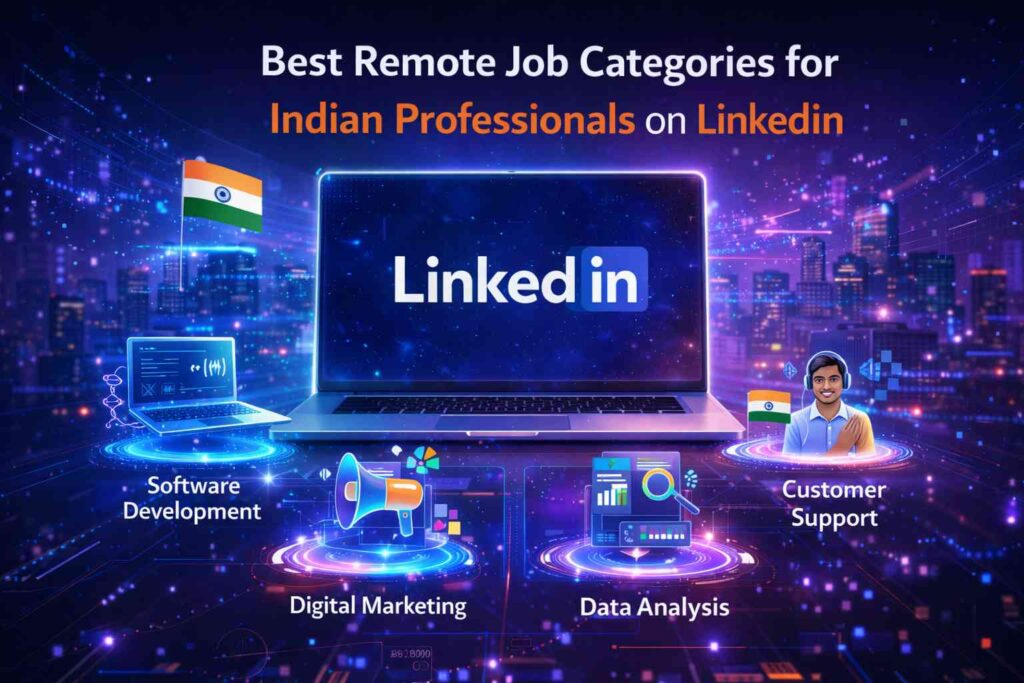
1. Software & IT Development
This is the largest and most lucrative remote job category for Indians. Companies worldwide desperately need talented developers.
Common remote job titles: Full-Stack Developer, Backend Engineer, Frontend Developer, Mobile App Developer, DevOps Engineer, Cloud Architect, QA Automation Engineer.
Why it’s ideal for Indians: Strong technical education, competitive cost advantage, and global demand for engineering talent.
2. Digital Marketing & Content
The rise of digital transformation has created massive demand for digital marketers, content creators, and SEO specialists.
Common remote job titles: Digital Marketing Manager, Content Writer, SEO Specialist, Social Media Manager, Email Marketing Specialist, Marketing Analyst.
Why it’s ideal for Indians: Excellent English proficiency, creativity, and ability to create content for global audiences.
3. Customer Support & Operations
Companies need 24/7 customer support, and Indian professionals can cover non-US time zones effectively.
Common remote job titles: Customer Success Manager, Technical Support Engineer, Operations Coordinator, Business Analyst, Customer Support Specialist.
Why it’s ideal for Indians: Strong communication skills, patience, and ability to work across multiple time zones.
4. Design & Creative Services
Graphic designers, UI/UX designers, and video editors find abundant remote opportunities.
Common remote job titles: UI/UX Designer, Graphic Designer, Video Editor, Motion Graphics Designer, Creative Director.
Why it’s ideal for Indians: Creative talent, competitive rates, and portfolio-driven hiring.
5. Data & Analytics
Data science, business analytics, and data engineering roles are highly remote-friendly.
Common remote job titles: Data Scientist, Data Analyst, Business Analyst, SQL Developer, Analytics Engineer.
Why it’s ideal for Indians: Strong quantitative skills and problem-solving abilities.
6. Virtual Assistance & Administrative
Executive assistants, project coordinators, and virtual assistants increasingly work remotely for global clients.
Common remote job titles: Virtual Assistant, Executive Assistant, Project Coordinator, Administrative Specialist, HR Coordinator.
Why it’s ideal for Indians: Strong organizational skills and excellent English communication.
Table: Top Remote Job Categories with Typical Salary Ranges
| Job Category | Entry-Level (USD/year) | Mid-Level (USD/year) | Senior (USD/year) | INR Equivalent (Mid-Level) |
|---|---|---|---|---|
| Software Development | $40,000–$60,000 | $80,000–$120,000 | $150,000–$250,000 | ₹66–99 lakhs |
| Data Science | $50,000–$70,000 | $90,000–$130,000 | $160,000–$260,000 | ₹74–107 lakhs |
| Digital Marketing | $35,000–$50,000 | $65,000–$95,000 | $120,000–$180,000 | ₹54–79 lakhs |
| UI/UX Design | $40,000–$60,000 | $75,000–$110,000 | $130,000–$200,000 | ₹62–91 lakhs |
| Customer Success | $30,000–$45,000 | $55,000–$80,000 | $100,000–$150,000 | ₹45–66 lakhs |
| Virtual Assistant | $20,000–$30,000 | $35,000–$50,000 | $60,000–$90,000 | ₹29–41 lakhs |
Note: Salaries vary based on company size, location (time zone), and specific skills. These figures are approximate as of 2026.
How to Apply and Get Noticed
Customizing Your Application
Generic applications are your enemy. Remote employers receive hundreds of applications, and they quickly filter out generic ones.
For each position you apply to:
- Read the job description thoroughly and identify 3-5 key requirements.
- Tailor your headline and summary to match the job keywords.
- Use the cover letter feature on LinkedIn to write a personalized note to the hiring manager.
- Reference specific projects or achievements that align with their needs.
- Show time-zone flexibility explicitly: “I’m comfortable working 2 PM–10 PM IST to overlap with US East Coast hours.”
Writing Compelling Cover Letters and Messages
Your LinkedIn cover letter or message to a recruiter should be concise (3-4 paragraphs) and action-oriented.
Template Message to Send Recruiters on LinkedIn:
Hi [Recruiter Name],
I came across the [Job Title] position at [Company Name] and was genuinely excited about the opportunity. My [X years] of experience in [relevant field] aligns well with your requirements, particularly in [mention 2-3 specific skills from the job description].
I recently completed [mention a relevant project/achievement/certification] which resulted in [quantifiable outcome]. I’m particularly drawn to [Company Name] because of [specific reason—mention their product, mission, or culture].
I’m comfortable working across multiple time zones and have successfully collaborated with distributed teams in the past. You can review my portfolio/GitHub at [link]. I’d love to discuss how I can contribute to your team.
Best regards, [Your Name]
Networking with Recruiters and Remote-Friendly Companies
Don’t just apply to jobs—build relationships.
- Follow companies you’re interested in and engage with their posts.
- Connect with recruiters at those companies with a personalized message.
- Join LinkedIn groups related to remote work, your industry, and Indian professionals.
- Attend LinkedIn Live events hosted by remote companies or industry experts.
- Engage thoughtfully with posts about remote work—comment with genuine insights, not generic praise.
Using LinkedIn Features to Boost Your Visibility
Publish Articles and Posts
Remote employers want to see that you’re engaged with your industry. Write short posts (once a week) about topics relevant to your field:
- “5 Tools That Transformed My Remote Workflow”
- “Lessons from Collaborating Across 5 Time Zones”
- “Building Scalable Systems: A Case Study”
Posts increase your visibility and establish you as a thought leader in your niche.
Engage in Relevant Groups and Communities
Join LinkedIn groups focused on remote work, your industry, and Indian professionals. Participate in discussions, answer questions, and share insights. This increases your visibility to recruiters scouting group members.
Leverage Recommendations and Endorsements
Request recommendations from former managers, colleagues, and clients. These carry significant weight with remote employers who cannot meet you in person. Aim for 5-10 thoughtful recommendations.
Endorse skills of others strategically—they’ll often reciprocate, boosting your skill endorsements.
Success Tips for Indian Applicants Targeting Remote Jobs
Communicate Time-Zone Flexibility Clearly
Remote companies worry about overlapping work hours. Be explicit: “I’m willing to work 2 PM–11 PM IST to cover US business hours” or “I’m flexible and can shift my hours as needed.” This removes a major objection.
Showcase English Communication Skills
For many remote roles, English communication is as important as technical skills. Your LinkedIn profile should be flawlessly written. Highlight any public speaking, writing, or communication achievements.
Highlight Remote-Relevant Tools
List your proficiency with remote work tools prominently:
- Communication: Slack, Microsoft Teams, Zoom, Google Meet
- Project Management: Asana, Jira, Monday.com, Trello
- Collaboration: Google Workspace, Notion, Figma
- Development: Git/GitHub, Docker, AWS, CI/CD tools
- Time Tracking: Clockify, Toggl (if applicable)
Build a Strong Portfolio or GitHub
For developers and designers, a public GitHub repository or portfolio website is invaluable. It proves your skills tangibly and is often required for remote roles.
Emphasize Reliability and Self-Motivation
Remote jobs require high discipline and self-management. In your profile and cover letters, highlight examples of independent project completion, self-directed learning, and meeting deadlines without supervision.
Common Mistakes to Avoid on LinkedIn
Incomplete or Unprofessional Profiles
Never send job applications from an incomplete profile. Missing experience dates, vague summaries, or no profile photo dramatically reduce your chances. Aim for 100% profile completion on LinkedIn’s scale.
Generic Applications
Avoid using LinkedIn’s auto-generated cover letter feature or sending the same message to every recruiter. Take 5 minutes to personalize each application. Remote employers notice and appreciate the effort.
Ignoring Networking Opportunities
Many remote jobs are filled through relationships, not applications. If you only apply without networking, you’re missing 50% of opportunities. Connect with recruiters, comment on posts, and engage with your industry community.
Poor Grammar and Spelling Mistakes
Your written communication is being evaluated constantly. Proofread everything—your headline, summary, posts, and messages. Use tools like Grammarly to catch errors.
Inconsistent Activity
LinkedIn’s algorithm favors active profiles. If your last login was 3 months ago, recruiters will assume you’re not actively looking. Log in weekly, engage with content, and update your profile regularly.
Not Setting Job Alerts
Checking LinkedIn manually for jobs is inefficient. Use job alerts to automatically receive matching opportunities. This ensures you apply early when competition is lower.
Conclusion: Start Your Remote Career Journey Today
LinkedIn is your gateway to remote opportunities that can transform your career and income. The competition is real, but so are the opportunities. By optimizing your profile, strategically searching for roles, and building meaningful professional relationships on the platform, you significantly increase your chances of landing that dream remote job.
Start today by updating your LinkedIn profile with the tips shared in this guide. Set up job alerts for roles that excite you. Connect with three recruiters in your field. Publish one thoughtful post about your professional interests. These small actions compound over time and position you for success.
The remote work revolution is here, and Indian talent is in high demand globally. LinkedIn is your most powerful tool to access these opportunities. Take action now, stay consistent, and watch as remote career possibilities unfold before you.
Your next great opportunity is just one LinkedIn search away. Make your move in 2026.
Website: www.remotecareerguide.com